
































The Salt Lake Tabernacle: Where Faith, Music and a Great Date Come Together

The Salt Lake Tabernacle and Its Magnificent Organ: Where Faith, Music, and Pioneer Ingenuity Meet
There are buildings that are impressive because they are large. There are buildings that are beautiful because of their architecture. And then there are buildings that seem to have a personality of their own. The Salt Lake Tabernacle is one of those buildings.
Standing on Temple Square in Salt Lake City, Utah, the Tabernacle has been a gathering place for Latter-day Saints for more than 150 years. It has hosted general conferences, worship services, concerts, broadcasts, celebrations and countless other gatherings. And above it all stands one of the world's most famous pipe organs.
For Latter-day Saints, however, the Tabernacle represents something more than clever nineteenth-century engineering. It is a reminder of the faith, sacrifice and determination of the pioneers who built it—and of the generations of Saints who have gathered inside it since.
President Gordon B. Hinckley once called it "a miracle building" and said that, considering the circumstances in which it was constructed, "there must have been great inspiration behind that skill." He described it as "truly a tabernacle, built in the wilderness from which the voice of the servants of the Lord should go forth to the world."
That is quite a compliment for a building that began with little more than a vision, some determined pioneers and a rather extraordinary roof.
Built in the Wilderness
Construction began in 1863, only sixteen years after the first Latter-day Saint pioneers entered the Salt Lake Valley.
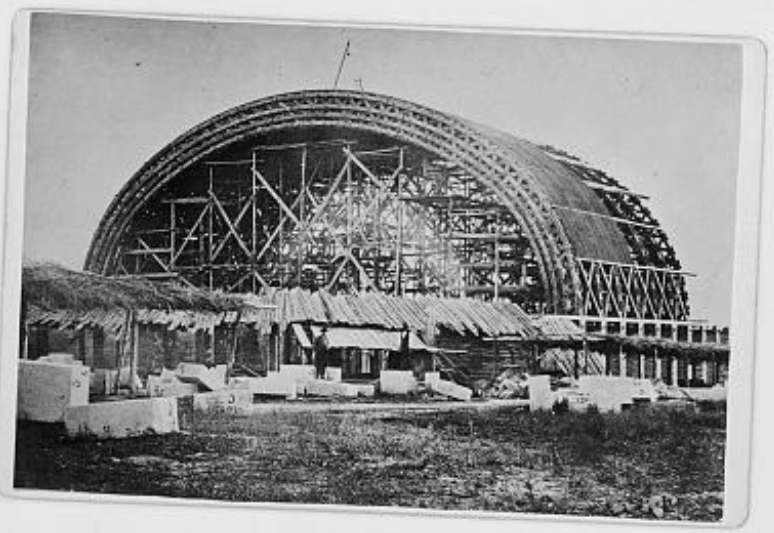
The circumstances were hardly ideal for building one of the largest meetinghouses of its kind in the world.
The Tabernacle under construction. A remarkable reminder of what pioneer builders accomplished with nineteenth-century technology.
Salt Lake City was still a developing frontier settlement. There was limited industrial infrastructure, difficult transportation and a shortage of many of the materials that would have been readily available to builders in established American cities.
A remarkable reminder of what pioneer builders accomplished with nineteenth-century technology
Yet Brigham Young wanted a great gathering place.
The Tabernacle eventually measured approximately 150 feet wide and 250 feet long, with its great elliptical roof spanning the entire width without the need for interior columns supporting it. Henry Grow, an experienced millwright, developed the remarkable roof structure with assistance from Church architect William H. Folsom. Think about that for a moment!
A huge wooden roof was designed to span a building approximately 150 feet wide—without a forest of pillars in the middle blocking people's view of the speaker. And this was happening in the 1860s.
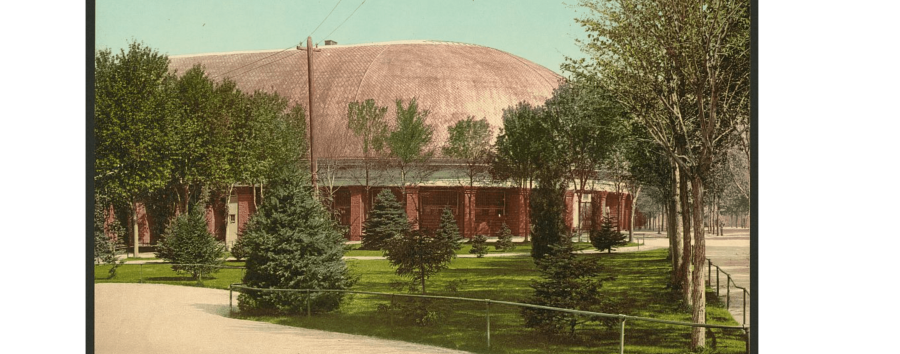
The construction techniques were ingenious. Wooden trusses were carefully designed and joined, with wooden pegs and wedges used extensively. The builders also learned from earlier structures and improved their techniques as they went along. Church historians have described the result as "a startlingly modern building for its time" and essentially unprecedented in the world.
Historic color photograph of the Salt Lake Tabernacle in approximately 1900.
The construction techniques were ingenious. Wooden trusses were carefully designed and joined, with wooden pegs and wedges used extensively. The builders also learned from earlier structures and improved their techniques as they went along. Church historians have described the result as "a startlingly modern building for its time" and essentially unprecedented in the world.
There is a wonderfully Latter-day Saint lesson in that. The pioneers didn't have everything they wanted.
They simply did what they could with what they had—and then figured out how to do it better.
The Tabernacle and the Sound of the Saints.
The building was sufficiently complete for general conference in October 1867, although work continued for several years. The Tabernacle was finally dedicated in October 1875 by John Taylor.
But there was an interesting problem. A giant room is not necessarily a good place to hear someone speak.
The Tabernacle's unusual shape created acoustic challenges. Various solutions were tried, including curtains and other modifications. Eventually, the balcony was constructed in such a way that it helped control the echoes and improve the acoustics. The result became famous.
The building's acoustics were so sensitive that stories circulated about a pin dropped near the pulpit being audible at the back of the hall. Whether you want to test that claim yourself or simply enjoy the architecture, the acoustics remain one of the Tabernacle's most fascinating characteristics.
And this is where the building and the organ become inseparable.
Because the Tabernacle doesn't merely contain an organ.
The Tabernacle and its organ have a sound.
The Organ That Came from Australia. The story of the Tabernacle organ is almost as remarkable as the building itself.
Brigham Young asked Joseph Harris Ridges, a talented organ builder from Australia, to construct the instrument.
Ridges was only 35 when he was given the assignment. Before the age of modern manufacturing, a pipe organ was an extraordinarily complicated piece of machinery. Ridges had previously built an organ in Australia, and the Tabernacle organ would become his second major instrument.
The materials had to be found and transported under frontier conditions.
Some of the wood came from the Pine Valley and Parowan areas of southern Utah—roughly 300 miles from Salt Lake City. Volunteers and teamsters had to haul enormous quantities of timber over difficult terrain. At times, as many as twenty wagon teams, each pulled by multiple yokes of oxen, were involved in transporting materials.
And then there is one of those wonderfully improbable pioneer stories: parts of the organ that Ridges had built in Australia were transported by ship to California and then hauled overland to Salt Lake City, with twelve mules helping pull the load across the rugged terrain.
Perspective is everything. Today, we complain when Amazon takes three days. The pioneers needed twelve mules.
From 700 Pipes to 11,623
The organ played its first important public role during the October 1867 general conference. It was not yet the enormous instrument we see today. The original instrument had approximately 700 pipes, two manuals and twelve working stops.
It grew considerably over the following decades.
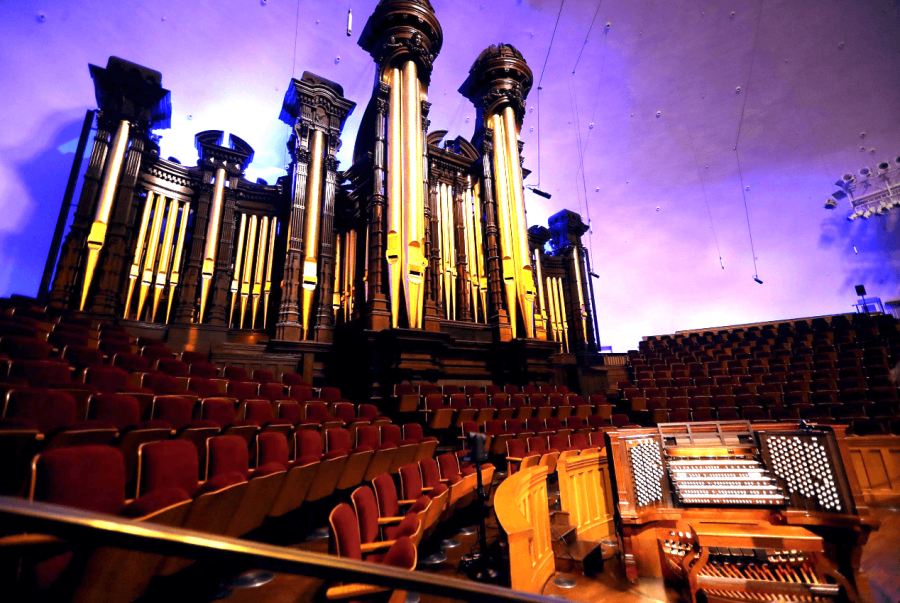
The organ was expanded, rebuilt and modernized repeatedly. In 1908, daily organ recitals began at Temple Square. In 1915, the casing was expanded by fifteen feet on each side to accommodate additional pipes. By 1949, a major rebuilding had produced an instrument with more than 10,000 pipes.
Today the organ has 11,623 pipes, 147 stops and 206 ranks, along with five keyboards.
Salt Lake Tabernacle organ with its thousands of pipes inside the historic Tabernacle in Salt Lake City, Utah.
That makes it one of the world's great pipe organs.And those numbers don't really communicate what it feels like to hear it. A pipe organ can whisper. It can sing. It can rumble. And it can produce a wall of sound that seems to fill every corner of the building.
The Tabernacle organ's distinctive voice became an important part of the sound associated with the Tabernacle Choir. The Church itself notes that the organ and the building contribute significantly to the Choir's "signature sound."
More Than a Place for General Conference
For generations, the Tabernacle was closely associated with general conference.
Presidents of the Church from Brigham Young through Gordon B. Hinckley spoke from its pulpit, making the building a physical link to generations of Latter-day Saint history. It has also been used for worship services, stake conferences, musical performances, broadcasts and community events.
In 1929, the first broadcast of Music and the Spoken Word was transmitted from the Tabernacle. The program would eventually become one of the longest-running continuous network broadcasts in the United States.
The building has also welcomed remarkable visitors and performers. Twelve U.S. presidents have appeared there, along with figures such as Charles Lindbergh, Susan B. Anthony and Helen Keller. John Philip Sousa performed there in 1896, while violinist Jascha Heifetz gave a recital in 1935.
So while the Tabernacle is unmistakably a Latter-day Saint building, its story has also become part of the broader cultural history of Utah and the United States.
A Building That Still Lives
One of the most wonderful things about the Tabernacle is that it isn't simply a museum. It has continued to function.
The building underwent extensive renovation between 2005 and 2007, including structural, seismic, technological and acoustic improvements. The work allowed the historic structure to continue serving modern audiences while preserving its character.
The organ, meanwhile, continues to evolve.
A major renovation begun in 2025 has involved the assessment, refurbishment and replacement of more than 75,000 individual pieces. The project aims not merely to keep the organ functioning but also to recover historic sounds that had changed or disappeared over the years.
In other words, the pioneers built it. Later generations preserved it. And today's Saints continue caring for it. There is something rather beautiful about that continuity!
Why Every Latter-day Saint Should Visit
If you are visiting Salt Lake City, the Tabernacle is an obvious stop—but it is worth visiting even if you have seen photographs of it a hundred times.
Photographs cannot really communicate its scale. They cannot communicate the extraordinary roof. They cannot communicate the acoustics.
And certainly they cannot communicate what happens when thousands of pipes begin producing music inside that enormous wooden space.
President Thomas S. Monson once described the experience of seeing the historic Tabernacle filled to capacity as an "inspiring sight."
That feeling is part of the Tabernacle's appeal.
You can walk through the building and think about Brigham Young, Henry Grow, William Folsom and Truman Angell.
You can look toward the organ and imagine Joseph Ridges working on an instrument that would outlive him by generations.
You can sit on the historic benches and remember that generations of Saints have sat in those same seats.
And then, if you're lucky enough to hear the organ played, you can simply sit quietly and listen.
Sometimes you don't need a sermon. Sometimes the music is enough. And Yes, It Makes a Wonderful Date
Here is another reason to visit the Tabernacle: it's a surprisingly good date location.
For one thing, it is difficult to have an awkward conversation when a gigantic pipe organ is producing magnificent music.
Second, it gives you something to talk about afterward.
"Did you hear that?"
"How many pipes did they say?"
"Do you think twelve mules really pulled that thing?"
"Should we get ice cream?"
Suddenly you've got a date.
More seriously, visiting the Tabernacle makes a wonderful Latter-day Saint date because it provides a combination of history, beauty, music and spirituality without requiring either person to manufacture conversation.
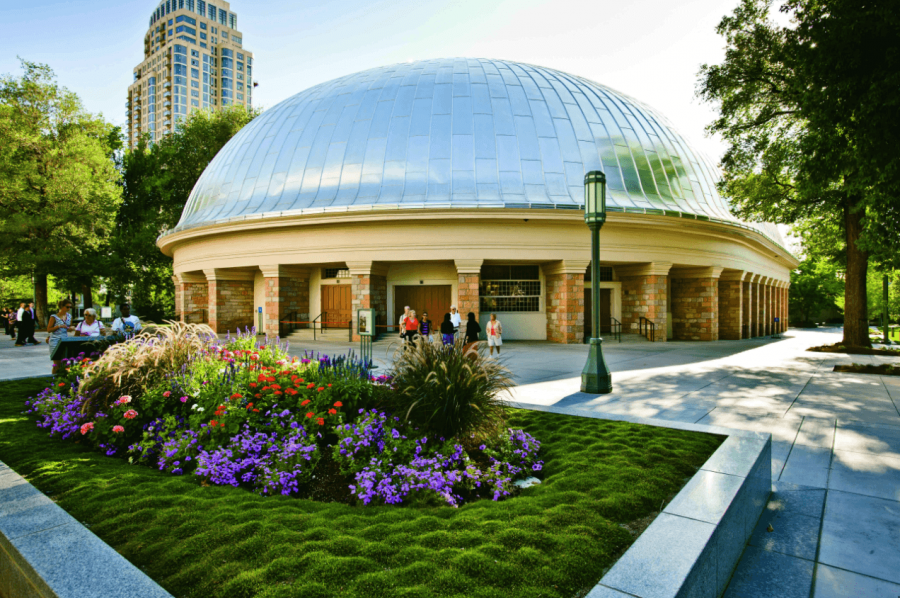
Salt Lake Tabernacle in Salt Lake City, Utah, historic Latter-day Saint meetinghouse on Temple Square with its distinctive oval roof.
.
Look at the architecture.
Visit the Tabernacle.
Listen to the organ.
Talk about your favorite hymns.
And then perhaps find somewhere nearby for dinner or dessert.
It is difficult to imagine a more wholesome way to spend an afternoon or evening together.
And if the relationship is going particularly well, you can even make the ultimate Mormon romantic gesture:
"Would you like to come to church with me?" Of course, if you're both members, that's not flirting. That's basically a joint calendar commitment.
A Legacy of Faith and Ingenuity.
The Salt Lake Tabernacle is impressive because of its architecture.
It is famous because of its organ.
It is historically significant because of the generations of Latter-day Saints who gathered there.
But perhaps its greatest significance is what it represents.
The pioneers arrived in the Salt Lake Valley with remarkably limited resources. Yet they built something extraordinary.
They built a place where people could gather.
They built a place where the word of God could be preached.
They built a place where hymns could rise into the air.
And they built something that has continued to inspire people long after the original builders were gone.
Brigham Young expressed his anticipation for the organ with a wonderfully simple purpose: "then we can sing the gospel into the hearts of the people."
That may be the perfect description of the Tabernacle.
It is architecture serving worship.
It is engineering serving music.
It is history serving memory.
And it is music serving faith.
So the next time you are in Salt Lake City, don't merely take a photograph of the Tabernacle from outside.
Go inside.
Sit down.
Look up.
Listen.
And for a few minutes, allow yourself to appreciate what the pioneers accomplished—and what generations of Latter-day Saints have preserved.
You might just feel something.
Perhaps it will be the Spirit.
Perhaps it will be the music.
Perhaps it will simply be awe at what a few determined nineteenth-century Saints managed to accomplish with wood, faith, ingenuity and a truly unreasonable number of organ pipes.
Probably all four.
Links:
https://www.thechurchnews.com/spoken-word/
https://www.thetabernaclechoir.org
- Sep 19, 2026
- 98 views